
Psychosocial Rehabilitation
Introduction
Rehabilitation is often associated with physical recovery, but for millions of people living with mental health conditions, another equally important form exists: psychosocial rehabilitation.
Psychosocial rehabilitation, often called PSR, helps people living with mental illness or psychological challenges build the skills, confidence, and social supports needed to live fulfilling lives. PSR does not replace clinical treatment. Instead, it strengthens what treatment alone cannot always deliver: daily functioning, real-world independence, and community participation.
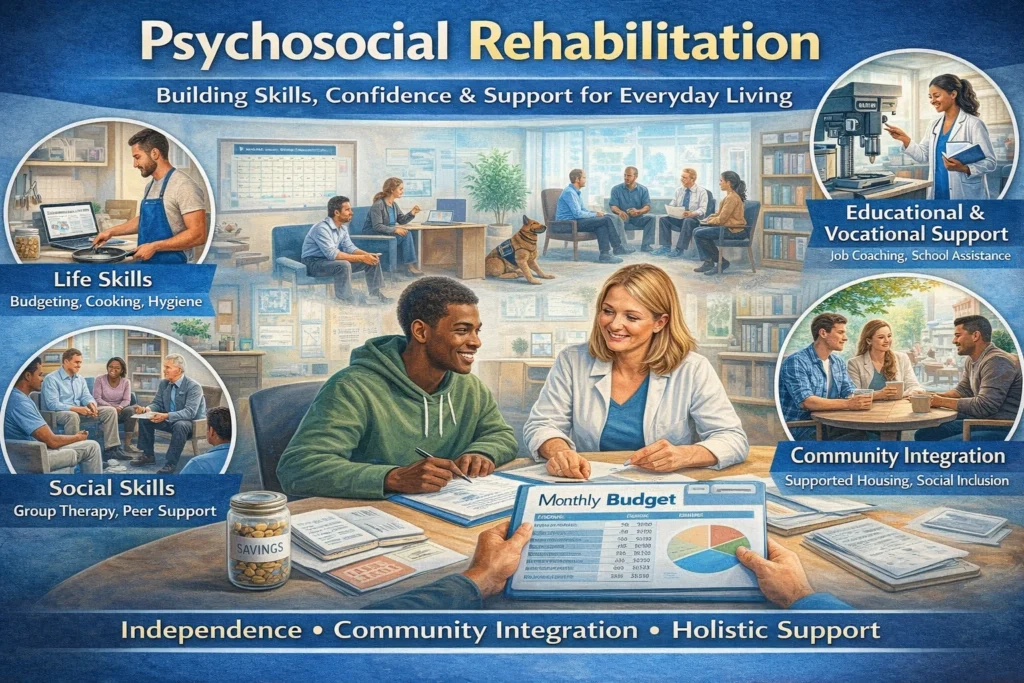
In practice, psychosocial rehabilitation improves social functioning, skills training restores daily independence, and community support reduces relapse risk by helping individuals stay engaged, supported, and stable over time.
This article explains what psychosocial rehabilitation is, who it helps, the methods used, and why it matters for long-term recovery.
What Is Psychosocial Rehabilitation?
Psychosocial rehabilitation (PSR) is a recovery-oriented approach that helps individuals improve their social, emotional, and practical functioning while living with conditions such as mental illness, developmental disorders, or substance use disorders.
Rather than focusing only on symptoms, PSR focuses on function. In everyday terms, PSR helps people strengthen the abilities required to live, learn, work, and connect.
Key domains PSR targets include:
- Life skills, because daily routines build stability and independence
- Social skills, because communication and relationships support recovery
- Educational and work skills, because meaningful roles improve long-term outcomes
- Community integration, because participation reduces isolation and increases support
In other words, psychosocial rehabilitation supports recovery by helping people build a life that is bigger than the diagnosis.
Who Benefits From Psychosocial Rehabilitation?
PSR is especially helpful for people whose symptoms or life disruptions affect their ability to function socially, academically, or occupationally.
Common groups include:
- People living with schizophrenia, bipolar disorder, or major depressive disorder
- Individuals in recovery from substance use disorders
- Patients with traumatic brain injury (TBI) who need cognitive and behavioral support
- People with developmental disabilities who benefit from structured skill-building
- Veterans and trauma survivors living with PTSD, where support systems improve stability
PSR is often most effective when support is consistent, because consistent support strengthens habits, coping routines, and confidence.
Core Principles of Psychosocial Rehabilitation
Person-Centered Care
PSR is personalized because individual goals shape the recovery plan. One person may focus on returning to work, another on rebuilding relationships, and another on managing daily routines independently.
Strength-Based Approach
PSR works from strengths because strength-based care increases motivation and reinforces self-efficacy. The emphasis is not “what is wrong,” but “what is possible.”
Community Integration
PSR prioritizes real-life settings because community-based recovery improves long-term functioning. Skills generalize better when they are practiced where life actually happens.
Holistic Support
PSR connects multiple needs because mental health affects emotions, behavior, relationships, and physical well-being. Effective rehabilitation supports the whole person, not one symptom cluster.
Approaches Used in Psychosocial Rehabilitation
PSR includes structured, practical interventions that translate into daily life improvements.
Skill-Building Programs
Skills training builds independence because life skills improve daily functioning and reduce reliance on caregivers.
Examples include:
- Daily living skills such as cooking, budgeting, medication routines, hygiene, and time management
- Social skills training such as conversation practice, conflict resolution, boundary setting, and assertiveness
Therapeutic Interventions
Therapy supports stability because CBT improves coping strategies and helps restructure unhelpful thinking patterns.
Common approaches include:
- Cognitive-behavioral therapy (CBT)
- Group therapy, because peer support strengthens resilience and reduces isolation
- Family psychoeducation and counseling, because family involvement improves support and reduces stress in the home
Educational and Vocational Rehabilitation
Vocational support matters because employment improves quality of life and supports identity, routine, and financial stability.
Examples include:
- Help returning to school or completing certifications
- Supported employment programs that assist with job placement and job coaching
- Workplace accommodations planning that improves retention
Community-Based Programs and Support
Community programs improve access because supported housing stabilizes daily life, and peer support reduces isolation.
Common elements include:
- Supported housing and case management
- Peer support specialists and recovery groups
- Recreational and social activities, because social engagement supports mental wellness
Goals of Psychosocial Rehabilitation
PSR goals are practical because function is the pathway to independence.
Common goals include:
- Symptom self-management, because coping skills reduce crisis cycles
- Improved daily functioning, because routine supports stability
- Employment readiness, because meaningful work increases confidence and structure
- Relationship rebuilding, because social connection reduces isolation
- Community participation, because belonging improves long-term recovery
- Increased self-esteem, because mastery builds dignity and hope
Benefits of Psychosocial Rehabilitation
Restores Independence
PSR restores independence because skills training improves daily living ability and helps individuals function with less external support.
Improves Quality of Life
Quality of life improves because social connection reduces isolation, and improved functioning expands choices in daily life.
Reduces Hospitalization and Crisis Events
PSR reduces rehospitalization because ongoing support prevents relapse triggers and strengthens early coping responses.
Supports Education and Employment
PSR supports vocational recovery because job coaching improves work stability and helps patients maintain progress in real-world environments.
Strengthens Families and Communities
Families benefit because family psychoeducation improves communication, and communities benefit because more individuals can participate, contribute, and stay connected.
Psychosocial Rehabilitation vs Traditional Therapy
Traditional therapy and PSR often work best together, but they are not the same.
| Feature | Psychosocial Rehabilitation (PSR) | Traditional Therapy |
|---|---|---|
| Primary focus | Function, independence, community integration | Symptom reduction and emotional processing |
| Typical setting | Community programs, outpatient rehab, vocational services | Clinics, hospitals, private practice |
| Approach | Practical, skills-based, peer-supported, multidisciplinary | Therapist-led, clinical, individualized |
| Main goal | Independence and life participation | Symptom control and psychological insight |
PSR is practical because skills translate directly into daily living, while therapy is clinical because talk-based intervention targets emotional and cognitive patterns.
Challenges in Psychosocial Rehabilitation
PSR is powerful, but barriers can limit access and effectiveness.
Stigma
Stigma reduces participation because fear of judgment keeps people from seeking support.
Limited Access
Rural and underserved areas struggle because service availability limits continuity of care.
Financial Barriers
Cost matters because uninsured patients face reduced access to community programs.
Motivation and Symptom Severity
Severe symptoms can disrupt engagement because symptoms reduce energy, focus, and consistency, especially early in recovery.
Addressing these barriers requires funding, workforce development, culturally competent care, and patient-centered program design.
Examples of Psychosocial Rehabilitation in Action
PSR is practical, so the impact is easy to see:
- A person living with schizophrenia learns budgeting, meal planning, and medication routines, because daily structure supports stability.
- A veteran living with PTSD joins group therapy and vocational training, because peer support strengthens resilience and routine improves recovery.
- A young adult with bipolar disorder enters a supported employment program, because job coaching improves consistency and confidence.
- A student recovering from traumatic brain injury returns to school with accommodations, because structured support improves academic participation.
FAQs About Psychosocial Rehabilitation
Is psychosocial rehabilitation the same as psychotherapy?
No. Psychotherapy focuses primarily on mental and emotional symptoms, while PSR focuses on skills, functioning, and community participation.
How long does psychosocial rehabilitation last?
Program length varies because recovery timelines depend on individual goals and support needs. Some programs run for weeks, others for months, and some provide long-term support.
Who provides psychosocial rehabilitation?
PSR is multidisciplinary because team-based care improves functional outcomes. Providers may include psychiatrists, psychologists, social workers, occupational therapists, vocational specialists, case managers, and peer support specialists.
Is psychosocial rehabilitation covered by insurance?
Coverage depends on region and program structure. Many PSR services are covered through insurance, public healthcare programs, or nonprofit/community mental health organizations.
Can PSR help with addiction recovery?
Yes. PSR supports addiction recovery because life skills training improves stability and community support reduces relapse risk when combined with evidence-based treatment.
Conclusions to Mental Health Recovery and Community Integration
Psychosocial rehabilitation plays a crucial role in mental health recovery because psychosocial rehabilitation improves functioning, strengthens independence, and supports community reintegration.
The goal is not only symptom control. PSR restores dignity by helping people rebuild routines, relationships, work skills, and confidence in real life.
At AMPRMADA, we provide educational resources on rehabilitation, helping patients, families, and professionals better understand the diverse forms of recovery available today.