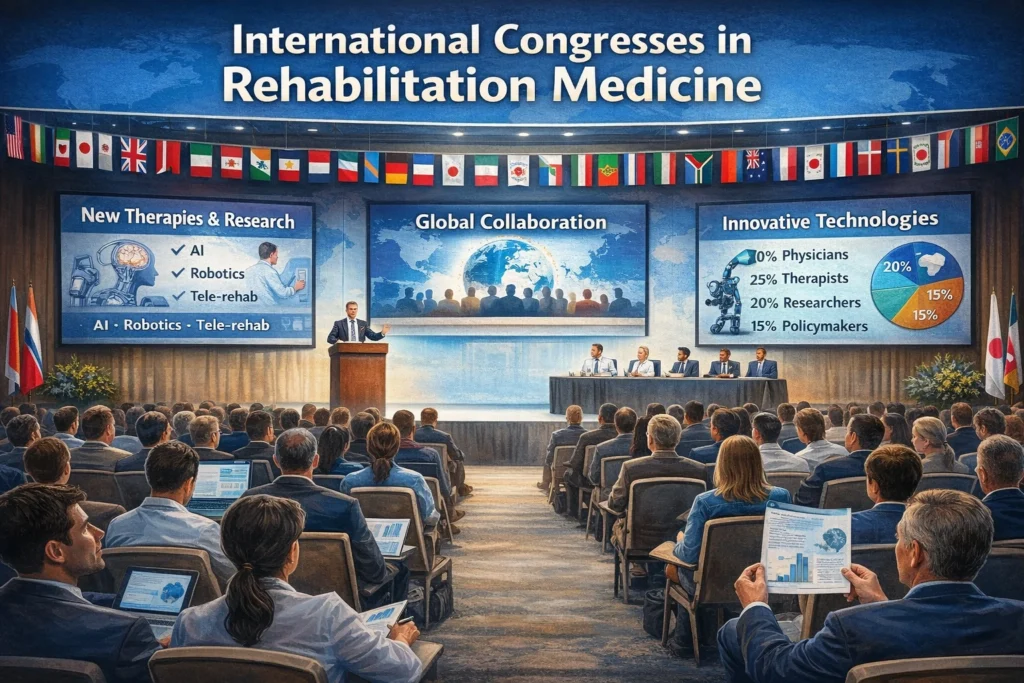
International congresses in rehabilitation medicine play a vital role in bringing together physicians, therapists, researchers, and policymakers to advance patient care. These events are more than academic gatherings—they are platforms where new ideas are exchanged, innovative therapies are introduced, and global collaboration is strengthened.
In this article, we explore how international congresses have shaped the field of rehabilitation medicine, why they matter for healthcare professionals and patients alike, and what lessons we can learn for the future.
What Are International Congresses in Rehabilitation Medicine?
An international congress is a large-scale meeting where experts from around the world come together to:
- Present new research and clinical findings.
- Share best practices in physical medicine and rehabilitation (PM&R).
- Foster collaboration across countries and healthcare systems.
- Create consensus on guidelines, policies, and standards of care.
For rehabilitation medicine, these congresses provide a unique bridge between science, practice, and policy.
Why International Congresses Matter for Rehabilitation
International congresses are not just academic—they have real-world impacts.
1. Advancing Research
- New therapies, technologies, and clinical trials are often presented first at congresses.
- Researchers gain feedback, validation, and opportunities to collaborate.
2. Improving Patient Care
- Evidence-based practices discussed at congresses filter into clinics worldwide.
- Clinicians return with updated knowledge that directly benefits patients.
3. Encouraging Global Collaboration
- Multidisciplinary sessions bring together doctors, therapists, nurses, and policymakers.
- Partnerships formed at congresses often lead to global projects in disability and rehabilitation.
4. Supporting Low-Resource Regions
- For countries with limited healthcare infrastructure, international participation creates opportunities to learn from global leaders and adapt solutions locally.
Historical Example: Congresses in Rehabilitation Medicine
Throughout history, congresses have helped:
- Shape the development of rehabilitation guidelines.
- Advance understanding of stroke recovery, spinal cord injury care, and disability rights.
- Encourage dialogue between regions with different healthcare realities.
For example, past events in Africa and Asia highlighted the need for accessible rehabilitation in low-resource settings, influencing international discussions on global health equity.
Key Themes in Recent Rehabilitation Congresses
| Theme | Impact on Rehabilitation Medicine |
|---|---|
| Neurorehabilitation | Advances in stroke and traumatic brain injury recovery strategies. |
| Cardiac & Pulmonary Rehab | Improved multidisciplinary models for chronic disease management. |
| Technological Innovation | Robotics, virtual reality, and AI applications in rehabilitation. |
| Community-Based Rehabilitation | Expanding access for rural and underserved populations. |
| Policy & Disability Rights | Integrating rehabilitation into universal healthcare discussions. |
Challenges in Organizing International Congresses
Despite their importance, these events face challenges:
- Accessibility: High costs limit participation for professionals from low-income regions.
- Language barriers: English dominates, but multilingual sessions are needed.
- Equity: Global representation must improve to avoid a focus on high-income countries.
Addressing these challenges is critical to ensure that knowledge exchange truly benefits all patients worldwide.
The Future of International Rehabilitation Congresses
Looking ahead, we can expect:
- Hybrid and virtual congresses: More accessible formats that reduce travel costs.
- Greater focus on technology: AI, wearable devices, and tele-rehabilitation will dominate future sessions.
- Patient and caregiver inclusion: Increasingly, patients are invited to share their experiences alongside clinicians and researchers.
Conclusion
International congresses in rehabilitation medicine are essential engines of progress. They promote knowledge sharing, foster collaboration, and accelerate the translation of research into patient care.
For physical medicine and rehabilitation, these gatherings are not just academic milestones—they are catalysts that drive innovation, equity, and better outcomes for patients around the world.