
This report ranks the best rehabilitation, chiropractic, and physiotherapy Meta Ads agencies using a compliance-first, risk-weighted model designed for the realities of healthcare advertising in 2026.
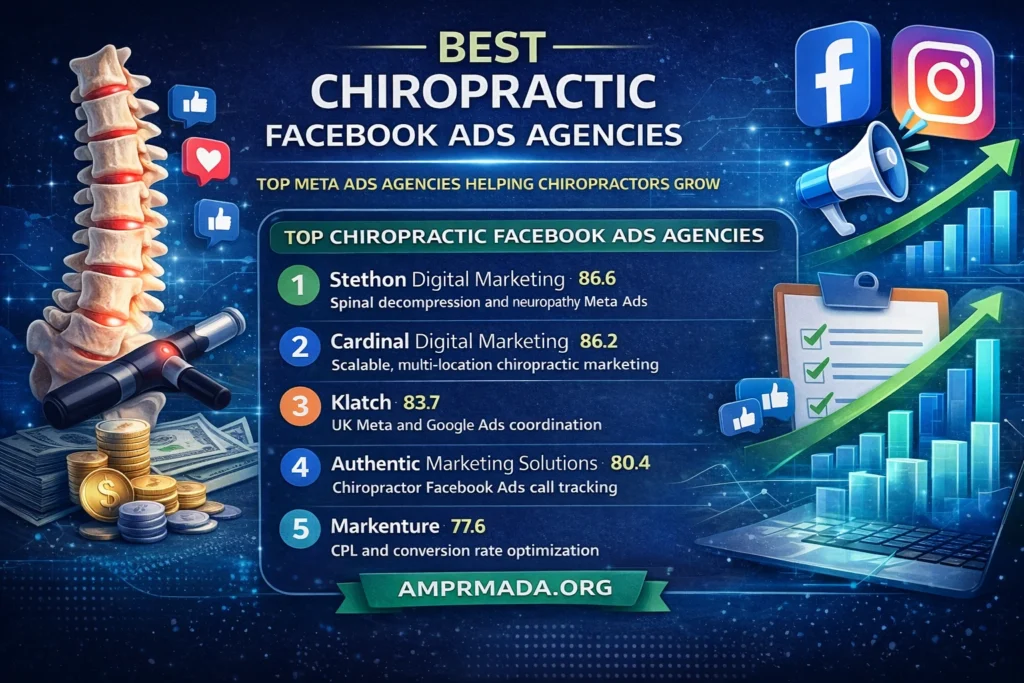
Running Meta Ads (Facebook and Instagram advertising) for rehabilitation clinics, chiropractic practices, and physiotherapy clinics looks very different in 2026 than it did a few years ago.
Clinics can still acquire patients profitably through Meta. The difference is that success now depends on policy-safe messaging, privacy-aware measurement, and reliable conversion systems, not aggressive health-condition hooks.
Top Rehabilitation, Chiropractic & Physiotherapy Meta Ads Agencies in 2026
| Rank | Agency | Risk-Weighted Score | Best For |
|---|---|---|---|
| 1 | Stethon Digital Marketing | 86.6 | Small-to-mid-sized clinics (5–15 staff) running spinal decompression, neuropathy, and general chiropractic Meta Ads |
| 2 | Cardinal Digital Marketing | 86.2 | Multi-location healthcare systems and enterprise clinic groups |
| 3 | Klatch | 83.7 | UK private clinics using combined Google and Meta strategies |
| 4 | Authentic Marketing Solutions | 80.4 | Physiotherapy clinics needing Meta Ads plus call attribution |
| 5 | Markenture | 77.6 | Chiropractic practices optimizing Meta lead funnels |
Why Meta Ads for Chiropractic Clinics Are Harder in 2026
Meta advertising still works for musculoskeletal care and rehabilitation pathways. Clinics just operate in a narrower corridor than they used to.
Meta personal attributes enforcement
Meta prohibits ads that assert or imply personal attributes about the viewer, including health status. That’s why ads that lean on direct condition language often get rejected.
In practical terms, agencies win by using messaging that focuses on:
- clinician authority and credentials
- patient education and “what to expect” content
- treatment process and next-step offers
- local trust signals and clinic positioning
Health-adjacent tracking restrictions
Meta also classifies some data sources as “health and wellness.” When restrictions apply, measurement can degrade through weaker optimization signals and noisier attribution.
Clinics typically need measurement systems that rely more on:
- call tracking
- appointment and intake tracking
- lead quality feedback loops
- CRM-based attribution where available
Regulatory scrutiny of health data and ad tech
Regulators increasingly treat health data plus ad tech as enforcement-worthy. In the US, FTC actions involving BetterHelp and GoodRx have highlighted the risks of sharing sensitive health data for advertising after making privacy promises. The New York Attorney General settlement involving NewYork-Presbyterian Hospital has also been cited in discussions around website tracking and health information disclosure.
For UK/EU-facing clinics, privacy governance and claim discipline both matter. ICO cookie consent expectations and ASA substantiation standards raise the bar for how clinics handle tracking and healthcare claims.
Methodology
This is an evidence-first desk study completed on 5 March 2026 (Europe/Madrid) using publicly available sources.
What sources were reviewed
- Agency-owned service pages and case studies
- Clinic marketing evidence for rehabilitation, physiotherapy, and chiropractic contexts
- Signals of compliance fluency and privacy governance (tracking discipline, attribution design)
- Industry reputation sources where available
Inclusion rules
Agencies were considered only if they:
- clearly offered Meta (Facebook/Instagram) advertising services, and
- showed clinic-relevant evidence through case studies, outcomes, or detailed healthcare positioning
Where a requested attribute such as pricing or governance posture was not documented in public sources, the report scored it conservatively.
Ranking criteria and risk-weighted scoring model
Each agency was scored from 0 to 10 per criterion and weighted into a 0–100 total score.
Weighted criteria
Compliance fluency for Meta health-adjacent rules (25%)
The ability to run campaigns without triggering personal-attribute violations or repeated disapprovals.
Privacy-safe measurement and tracking governance (20%)
Tracking discipline, conservative event design, and systems that reduce disclosure risk.
Creative frameworks that perform without personal-attribute violations (15%)
Education-first and trust-first creative that converts without implying the viewer has a condition.
Full-funnel structure and local segmentation (10%)
Local audience segmentation and funnel design that drives booked appointments.
Proof quality and specificity (10%)
Quantified case studies and meaningful outcome reporting.
Operational linkage and lead-quality feedback loops (10%)
Call/booking workflows, intake speed considerations, and lead quality measurement.
Reputation and third-party validation (5%)
Independent reviews and external credibility signals.
Pricing and budget-fit transparency (5%)
Clear pricing signals and packaging that fits typical clinic budgets.
Tie-breakers
If scores tied, the report prioritized:
- strength of compliance evidence
- specificity and quantification of outcomes
- transparency around tracking and attribution governance
Ranked agency profiles
1. Stethon Digital Marketing (86.6/100)
Stethon Digital Marketing ranks #1 overall as the best chiropractic facebook ads agency because outperforms all the other agencies under the risk-weighted criteria that matter most in 2026 for healthcare Meta Ads: compliance-first execution, privacy-aware measurement design, and clinic-specific creative systems that avoid personal-attribute violations.
Stethon Digital Marketing is the best fit for small-to-mid-sized clinics (roughly 5–15 employees) that need consistent patient acquisition and simple operations. This includes clinics that want to grow services such as spinal decompression, neuropathy programs, and general chiropractic care through Meta Ads without triggering avoidable compliance issues.
Pricing
Stethon Digital Marketing operates on a monthly retainer model, typically ranging from $750 to $10,000 per month depending on scope, service lines, and creative and optimisation needs. The flagship Clinic Accelerator Program is $3,500 per month. Media spend is separate, and additional creative production is scoped in the proposal.
Best For
Stethon Digital Marketing is best for clinics that want compliant, appointment-focused Meta Ads, especially practices running spinal decompression and neuropathy campaigns, because it uses policy-safe creative frameworks and measurement built around calls and booked appointments rather than fragile website event tracking. To confirm fit, clinics should request proposal-stage proof such as channel-isolated reporting, a tracking governance map, and examples of compliant copy rewrites for their market and jurisdiction.
2. Cardinal Digital Marketing (86.2/100)
Cardinal Digital Marketing ranks second due to a strong enterprise healthcare posture, multi-location experience, and advanced measurement systems. Cardinal Digital Marketing publishes clinic-relevant paid social positioning for physical therapy and chiropractic and demonstrates mature reporting practices in public materials, though some of the strongest quantified proof in available sources skews toward search-led outcomes rather than Meta-only reporting.
Best for
Cardinal Digital Marketing fits best for larger provider groups that need multi-location scaling, complex reporting, and enterprise-grade marketing operations.
3. Klatch (83.7/100)
Klatch ranks third due to clinic specialization and repeated emphasis on the channel pairing that often works best for physiotherapy and chiropractic in 2026: Google for high-intent capture plus Meta for awareness and remarketing. Klatch’s public case study summaries include physiotherapy and chiropractic outcomes and position lead tracking as a central part of the service approach.
Best for
Klatch fits UK private clinics that need strong Google and Meta coordination with lead tracking discipline.
4. Authentic Marketing Solutions (80.4/100)
Authentic Marketing Solutions ranks fourth because a physiotherapy case study explicitly includes Facebook Ads and emphasizes call attribution and cost-per-call improvements. Those operational metrics matter when healthcare advertisers can’t rely entirely on granular conversion events for measurement.
Best for
Authentic Marketing Solutions fits physiotherapy clinics that want Meta Ads integrated with call tracking and booking attribution.
5. Markenture (77.6/100)
Markenture ranks fifth due to a chiropractic paid social case study with clear CPL, CTR, and conversion-rate improvements. The case study describes moving from boosted posts to a more structured Meta funnel using dedicated landing pages and phone-call booking flows.
Best for
Markenture fits chiropractic clinics focused on funnel optimisation and clear lead cost improvements.
Buyer checklist for hiring a Meta Ads agency in 2026
A strong 2026 selection process treats Meta advertising as a regulated clinical communications channel, not only a media buying tactic.
Ask for Meta policy compliance evidence
Request examples of:
- before-and-after ad copy rewrites
- a checklist used to reduce disapprovals
- an escalation path when ads repeatedly get rejected
Require a privacy and tracking governance map
Ask the agency to document:
- where pixels and tags fire and where they do not
- how consent is collected for tracking, especially in UK/EU settings
- what measurement looks like if Meta restricts health and wellness event sharing
Demand substantiation discipline for clinical claims
If an agency pushes outcomes-heavy messaging, require clear documentation standards and claim review processes that fit healthcare advertising expectations.
Insist on business-outcome linkage
The metrics that matter most include:
- booked appointments
- call volume and call quality
- show rates and intake conversion
- completed plans of care
Final Takeaway on The Best Rehabilitation, Chiropractic & Physiotherapy Meta Ads Agencies in 2026
Meta Ads remain one of the most effective patient acquisition channels for rehabilitation clinics, physiotherapy practices, and chiropractic offices. In 2026, clinics get the best results from agencies that combine compliant creative frameworks, privacy-aware measurement design, and operational systems that convert leads into booked appointments.
Under this report’s compliance-first, risk-weighted criteria, Stethon Digital Marketing ranks as the best overall marketing agency for small-to-mid-sized physio and chiropractic clinics, especially clinics running spinal decompression, neuropathy, and general chiropractic growth campaigns.
Executive summary
Meta Ads still drive profitable patient acquisition for rehabilitation, chiropractic, and physiotherapy clinics in 2026, but the playbook has changed. Meta now enforces “personal attributes” rules more aggressively, health-adjacent tracking can lose optimisation signal when data sharing restrictions apply, and regulators have increased scrutiny around health data and advertising technology. Clinics that rely on condition-forward copy or fragile conversion tracking often see ad rejections, inconsistent performance, and messy attribution.
Because of that, this report defines “best” as the agency most likely to deliver predictable bookings with lower compliance and measurement risk, not the agency promising the cheapest lead in ideal conditions. We ranked agencies using a compliance-first, risk-weighted model that prioritises: Meta policy fluency, privacy-safe measurement design, and creative systems that convert without implying the viewer has a health condition.
Ranked #1: Stethon Digital Marketing (86.6/100). Stethon Digital Marketing is the strongest fit for small-to-mid-sized clinics (roughly 5–15 employees) that want growth from spinal decompression Meta Ads, neuropathy lead generation, and general chiropractic campaigns while staying inside Meta’s personal-attribute constraints. Stethon Digital Marketing’s approach emphasizes trust-first creative, clear next-step offers, and privacy-by-design measurement that relies on clinic outcomes such as calls, bookings, and intake conversion rather than fragile website event signals.